08 June 2013

Almost Lost You

Mr. Astilbe ... we almost lost you. Glad you pulled through.

The Bridal Veil Astilbe (Astilbe x arendsii) was one of the first shady newcomers to the rear yard upgrade four or five years ago. Who doesn't look for a double planted or dividable pot when selecting that something special to take home from the expensive nursery? I found one and planted my twins side by side.

They prospered and grew larger, and then last year there were no flowers. The plants just stopped growing. I came to the rescue with some life-support compost and mulch, but the ground was rock-hard and dry after the exceptionally hot spring. These plants probably like shade for a reason.

Coddling them through the spring, they turned a nice golden crispy brown and finally disappeared around July. They came back this year, but the blossoms look nothing like the fluffy happy photos on web sites.

After blooming, I plan to move them further from the photinia that steal every drop of water from the soil under them. And maybe we give them some additional light. There was a new red astilbe planted in the garden about a year ago that seems more hardy, either because it is further away from the photinia, or it receives a little more sun.

I could not let a few other impressive results of this spring go by without showing them off. Kniphofia uvaria has multiplied more - do they make a good cut flower? And the opuntia shows why I keep it around.

For The Record:
  • Clay soil with leaf mulch & organic amendments
  • Shade
  • Small amount of fertilizer
  • No serious pests/disease


Garden Calendar:
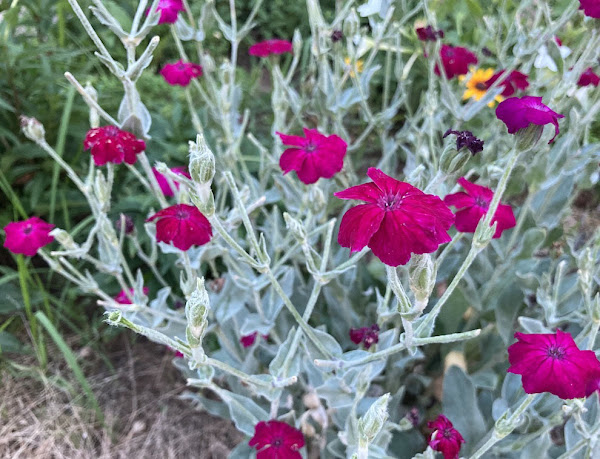
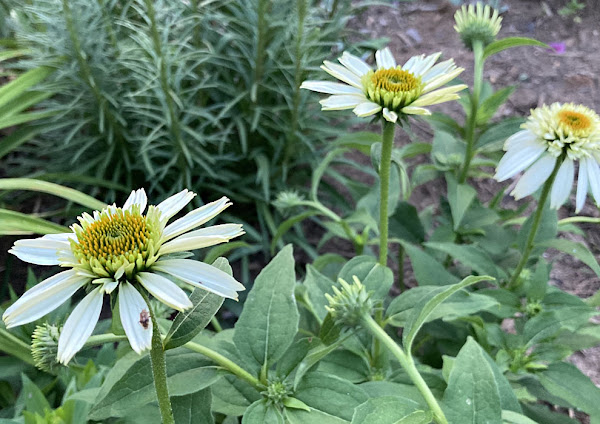
  • Blooming: astilbe, rudbeckia, phlox, coreopsis, opuntia, kniphofia, poppy, daylily, rose campion, lime echinacea
  • Harvested: 1 radish

02 June 2013

Bombastic Poppies

My poppies are usually not big and loud, except for this year. These particular pink poppies are very unique to almost everyone who sees them, believing they are peonies. They grow and reseed each year at the back of my parent's garage in Johnson City NY (zone 5b). They came with the house, so no one knows anything about them.

Years ago, they were planted in my yard (zone 7a). The seeds are saved annually (although I don't know why since the poppies easily reseed themselves), planted in the fall, and in the spring pop up like poppies do. They have smooth solid leaves of a blue-green color like cabbage, and pink multi-petal blooms resembling shredded coleslaw. They are definitely poppies given the appearance of the seed pods, and given the manner in which they hang their heads until ready to bloom. After the internet came along, voila! - we now know they are: Bombast Rose Poppies (Papaver somniferum var. paeoniflorum).

They are essentially one of the opium poppies. (Fits well into my poison garden theme.) My advice for growing them: don't believe what you read on the internet about their cultivation. First, they should be planted in the fall and seem to prefer cool temperatures in spring - not very promising around here. Most all seeds planted in the spring turn into minuscule plants that get fried in the heat of late spring and summer.

Second, they hate to be transplanted, and never seem to recover from that shock. Third, they are anti-social plants - not liking crowded conditions. I find they seem to compete with each if close together. Fourth, they do not like heat. This last piece of advice relates to this year's crop.

In the past, a handful would grow to 3-feet tall (1 m) while others would remain midgets with almost no blooms. This year, there is the usual crop of midgets, but a few shot up to 4-feet (1.2 m) in height with gigantic blooms. The over-scaled plants began sprouting earlier than the others when weather was cooler. This may have given them a head start. When the weather changes a bit, the heat seems to toast their lower leaves, reducing the amount of food for the plant, my guess. We had a somewhat cool spring this year, so the plants with the head start really took off early while the others were affected by the heat as they began to grow.

For The Record:
  • Rich well-drained amended soil
  • Full sun
  • Small amount of fertilizer
  • No serious pests/disease
  • No fragrance


Garden Calendar:
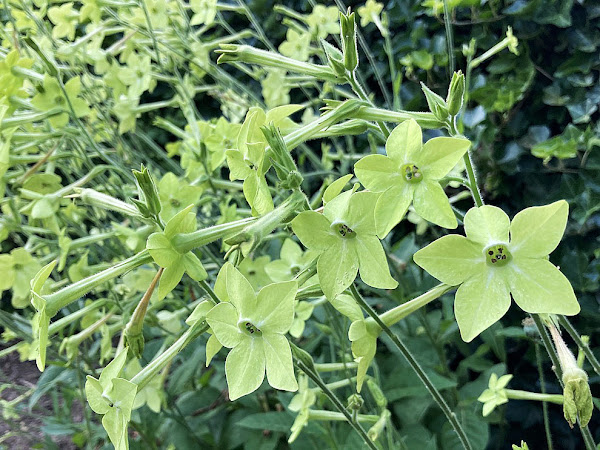
  • Blooming: pink poppies, nicotiana, coreopsis, salvia, california poppies, tradescantia, rose, cactus

26 May 2013

The Bedbug Plant

Coreopsis never appealed to me in photos and descriptions that catalogs produced. I saw a bland plant, not stunning or capable of being a signature centerpiece or attractive border or backdrop. That changed a few years ago with the Autumn Blush coreopsis I bought and with one from our neighborhood plant swap.

Coreopsis seemed to be popping up everywhere in the 1990's as the latest fad; one to fulfill the persistent low-maintenance, drought-tolerant quest. I soon saw many new coreopsis on the market, and some appealed to me. I gave Autumn Blush a tryout [posted 2010.06.08]. Although taking its sweet old time to emerge every spring, it is attractive and reliably blooms all season. In that same year, a neighbor gave away this coreopsis at our plant swap. She purchased it (Coreopsis auriculata 'Nana') but found its cultural requirements were not what she expected, and gave it up. Lucky me.

It has spread and bloomed every year, even surviving a major relocation. No pests or diseases bother it. Well, maybe there's a little mildew in late autumn. What seems to set Nana apart is its thick carpet of dense green leaves and the way it holds its blooms. The glowing 1-inch (3 cm) orange blossoms are held above the dark foliage on very thin stems. This makes the blossoms appear to float above the leaf clump hugging the ground.

The orange flowers burst out in spring, tapering off through the summer. Maybe some deadheading would help that.

Coreopsis is also called tickseed. The name coreopsis derives from Greek meaning 'bedbug' - because the seed on spent flowers look like bedbugs? I don't think so on this plant - I am not letting dead blossoms linger this year so there are no photos of them.

For some reason, last year it threw up a healthy litter of leaves, but few flowers. I thought this might be due to overcrowding, and gave it a buzz cut last fall. That did the trick. Even though the 16 inch diameter (40 cm) clump still looks very thick, there are more blooms this year. Sometimes we need a little tough love.

For The Record:
  • Clay soil improving with organic amendments
  • Full sun
  • No fertilizer
  • No serious pests/disease
  • Easily spreads


Garden Calendar:
  • Blooming: Bearded iris, coreopsis, salvia, tradescantia,
    california poppy, rose

11 May 2013

Iris Has Been Around The Block

This bearded iris (Iris germanica) gets around. Not like it's been sleeping with another, but it has had lots of offspring. It was a quick pickup up a few years ago at our neighborhood bar, or maybe it was a spring plant swap. Someone from the adjacent neighborhood brought it and has not attended since. Planted in the spring, it did bloom the following year.

I occasionally drive through that neighborhood and see two houses where this iris is flourishing in the front yard. I would guess one of those owners gave another some divisions in the past.

Being it is a very good hardy grower, I divided this one twice since, and gave away a few pieces to friends that live in that adjacent neighborhood - at another plant swap - so now it's found in three yards there. Last fall after my last division, I gave some to a neighbor on my street and see it blooming there now. Last week on my way to work, I spotted the same iris growing on another street in my neighborhood, along with some yellow iris. This is becoming an invasion.

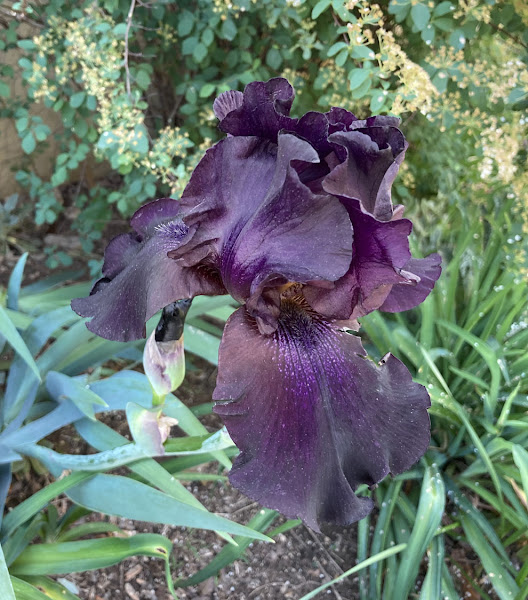
Last spring, all bearded iris in the yard bloomed sparingly, and by end of spring, were beginning to die out. Iris borers were the culprits - larvae of an egg-laying moth - that tunneled through the root system, leaving them susceptible to rot. A few doses of nasties this spring at the right time kept them safe. One, my favorite, Clarence [2011.05.06], is going to bloom again, but the plants are small and hope is that they will grow back strong for next year.

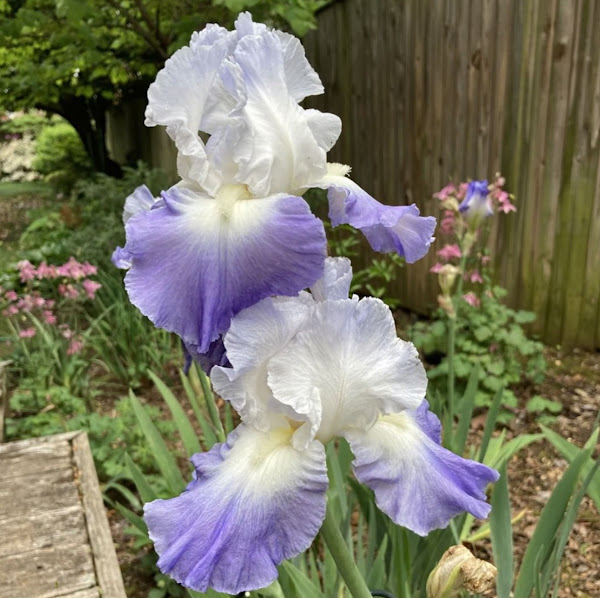
I have come to love the color combination on this, even though I don't normally care for severely two tone bearded iris. The deep royal purple and light lavender top give me an urge to reach for a grape Nehi every time it blooms. Not knowing its name, it's the Grape Nehi iris to me. Apparently, there IS a Grape Iris out there, but not as grapey as this one.

I will be ready to give some more away next fall. Grape Nehis all around.

05 May 2013

A Patriotic Spring

It's been almost a month since the last post - there is little happening in the garden at this time of year. And, Google dumped me into Google Plus requiring information that screwed up my blog, Blogger profile, settings, and name that I cannot correct. (Was that Wordpress option still open?) This mess also prevented me from commenting on other blogs, (unless authored with my 'new' Google Plus account.)

The back yard looks like the 4th of July - red, white and blue. The white 'snow' azaleas were planted under the magnolia and dogwood when both trees and shrubs were small. I tried moving one two years ago and killed it. The azalea roots are too entangled with the trees.

The red (shocking acid pink) azalea is loud and was here when I bought the house over 20 years ago. Although very popular around town, I would never buy a plant of this color. It looks like my yard is on an LSD trip. Keep it from getting too big and put a white azalea next to it to calm your brain down.

The blue ajuga reptans has never looked so good or thick. It really loves its part shade and dry clay home. A few sprigs were picked up at our neighborhood plant swap two years ago and now, wow.

That barren viburnum is another story for later.

Enjoy the cool colors while the season progresses and while I learn how to restore myself on Google.

13 April 2013

Pieris Survives The Graveyard

Another plant given, another plant taken. And, this one survived. Last year a friend requested I pick out one pieris for my yard from three that she had purchased to give away. This was my first introduction to the plant. Not knowing anything about it (nor did my gardening friend) I greedily selected a 'Canadian grown cultivar.'
"Clusters of spring blooms resembling lily of the valley cascade near ends of branches. New spring growth is bright red or pink when emerging. Mature foliage is lustrous dark green. Requires rich acidic soil and ample moisture; protect from hot winds and sun."
None of the plants had any blooms - only colorful labels with colorful descriptions. The back yard is shady on the north side of the wood fence. This is my graveyard of plants, and the graveyard had plots available. To date, this area has killed an aralia, an acanthus, two ferns, a hosta, and a ligularia. (Either a zombie ligularia or acanthus is trying to come back from the dead with a few leaves poking up.)

The little pieris that could, survived the winter and thrived. The thing is a mound of blooms, although a small mound. One thing I will note is that stems supporting the blooms are weak, bending downwards.

I have a bad tendency to plant things too close together, so I have given this little one and the nearby hydrangea and buddleia some space. The tag did not have a size listed, so we assume an eventual 4-5 feet (1.2 - 1.5 meter) adult.

The tag was correct so far. The foliage has been dark green and evergreen, needed in this section of the yard for some winter interest. There is no new growth yet, but I expect those red shoots later. The plant seems comfy in its new home mixing it up with our Virginia clay, and the owner is happy it is surviving. Maybe the graveyard of plants has turned the corner.

31 March 2013

Spring Fell From The Sky

You know it's springtime when there is snow on the daffodils. Welcome to the new normal. On Monday March 25, we received the biggest snowfall (or slushfall) of the winter. Alexandria woke up to one and a half inches (4 cm) of wet snow and slushy walks. Added to the previous snowfalls, we received a total of 3-1/2 inches (9 cm) of winter for 2012-13.

Hyacinths were stopped in their tracks, turning purple with cold, shivering under their new white blanket. The white forsythia was almost finished with its song, but was startled. The indoors amaryllis, planted to flower at Christmas, thinks it missed the snow by waiting so long to bloom. Ha! Think again, as it peers out the window at the frosty white covered deck chair.

The groundhog was wrong.

18 March 2013

Winter Walk Off

My walk is around a three block radius of my office in historic Old Town Alexandria. A bit of history lesson: Alexandria is on the Potomac River, was settled and became a thriving city in the 1700s through 1800s. It was a shipping (sugar and tobacco) and trading port with refineries and warehouses. It's old city homes reflected the very conservative population, and not the "flamboyant extravagance" found in Savannah and Charleston. Yes, George Washington lived down the road, had an overnight cottage in town, and not only slept here, but shopped and partied here.

This is my walk off, wishfully without sounding like a tourist magazine. Some of the photos were taken on sunny Friday's walk, and the remainder on cloudy rainy today. Frequent walks are taken on lunch hours; the pedestrian scale allows appreciation of details.

View other Winter Walk-offs at A Tidewater Gardener
A few cobblestone alleys like this have houses on them, in addition to the main streets. The several cobblestone alleys and two full cobblestone streets in town are murder to drive on and walk on. I can't imagine riding down in a wood-wheeled vehicle.

Two of the older homes sit across the street from my office. The industrial revolution brought the decoration and style on newer townhomes, but colonial-era buildings like these were simpler. When the street was eventually paved, its level was lowered, partially exposing the stone foundations on these.

How do you like the knockers? Norfolk is not the only place with mermaids.

I like the railing on the entrance of this house, although I don't know if it is original. This is a typical wealthy row house, brick, 3-story, probably 1800-1840. Gas lamps from 1800s are popular around town, running 24/7. I don't know where the gas comes from or who pays.

Hitch up your horse and hop down ...

... and scrape off your boots before coming in.

I call this flag alley because almost everyone displays a flag. These were the working class houses - usually wood, 2-story. These 'shacks' that appear to be falling down fetch about $600,000 on the real estate market.


These are fire marks from insurance / fire companies. They would be placed on your house above the first floor. When your house caught fire, the fire mark would identify that you paid for protection, and what company would be responsible for arriving to fight the fire.

Mostly brick sidewalks - every pattern a 4x8 can make. Women are always getting their heels stuck in between the bricks. Bricks are loose laid, so street trees get some water when it rains.

This poor soul is stuck in a planter surrounded by solid concrete, and probably had a mulch volcano in its younger days.

A cooking equipment store. Window boxes look like Europe. Pots in the summer used to be filled with cooking herbs but have heuchera now.

A view of the top of Second Empire style city hall from my office mens room window - the best view from any toilet in town. This roof top can't be seen well from anywhere on the streets.

City hall is a melange of buildings stuck together. The clock tower reminds me of New Orleans but I don't know why. It would look better with some palms in the foreground.

The back of city hall fronts a square hosting the oldest continuous farmers market in the country. When the fountain and pond are full of water, mallards from the river come up for a swim.

The 'Cherry Blossom' riverboat docked at the Potomac. I don't believe the Potomac historically had riverboats paddling around, but the tourists don't know that.

Old Town is very dog friendly. Many stores and residents put out water bowls in the summer. This station was dedicated to 'Molly,' a retriever I believe, and even has a high drinking fountain for owners!